Old Fitz Theatre, August 2
6/10
Hamlet is all the rage. In June, Eddie Izzard brought us one-hander, The Tragedy of Hamlet, and in January, the endearing curiosity that is Hamlet Camp, penned and performed by ex-Hamlets Brendan Cowell, Ewen Leslie and Toby Schmitz, returned to Carriageworks. Last year saw the movie Hamnet contextualising Shakespeare’s writing of the play, and Riz Ahmed starring in a new film version. Now Goodnight Sweet Prince fractures the work into shards of its text, performed by Jack Twelvetree and Raj Labade, and written by them and director Liesel Badorrek.
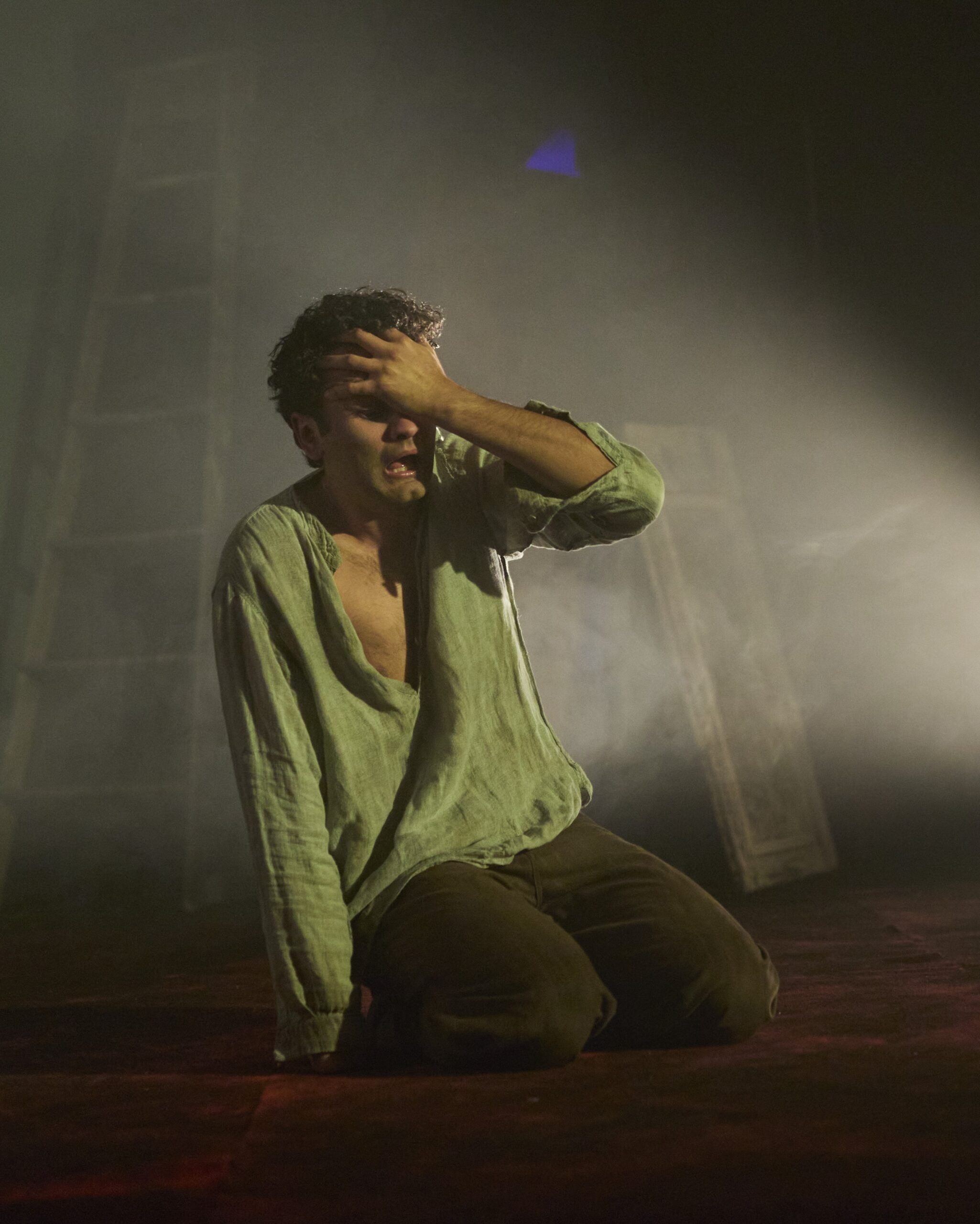
Like the acclaimed Schaubuhne Berlin production that visited in 2010, Goodnight Sweet Prince begins with “To be, or not to be”. With Schaubuhne, it seemed a cheeky ploy to dispense with the most famous speech, so they could get on with the play. Here, it’s a foretaste of a piece in which time is rendered multidimensional, like space in cubist painting.
The jarring and fracturing are taken as far as Labade and Twelvetree swapping roles on alternate nights, with one playing Hamlet and the other the rest of the relevant roles (other than Ophelia, who’s voiced by Catherine Laga’aia). For this show, Twelvetree was Hamlet, and Labade the others. You’d have to see it twice to know which was better. Labade would seem to have a more natural brooding intensity, but Twelvetree made for an unusual, wide-eyed and rather innocent Prince, bewildered to be caught in a maelstrom of war, incest and betrayal.
War is omnipresent, with Norway’s Fortinbras bombing the bejesus out of Elsinore. Blasts and gunfire assail us throughout; a chair hangs upside down from the ceiling; picture frames are awry. This thickens the reasons – beyond his father’s murder and his mother’s sudden marriage to newly crowned Uncle Claudius – for the unravelling of Hamlet’s mind; for pressure building upon a vulnerable psyche until it explodes. The piece is less about events than the protagonist’s reactions to them. The soliloquies, therefore, are preeminent, sometimes delivered with Horatio as Hamlet’s auditor.
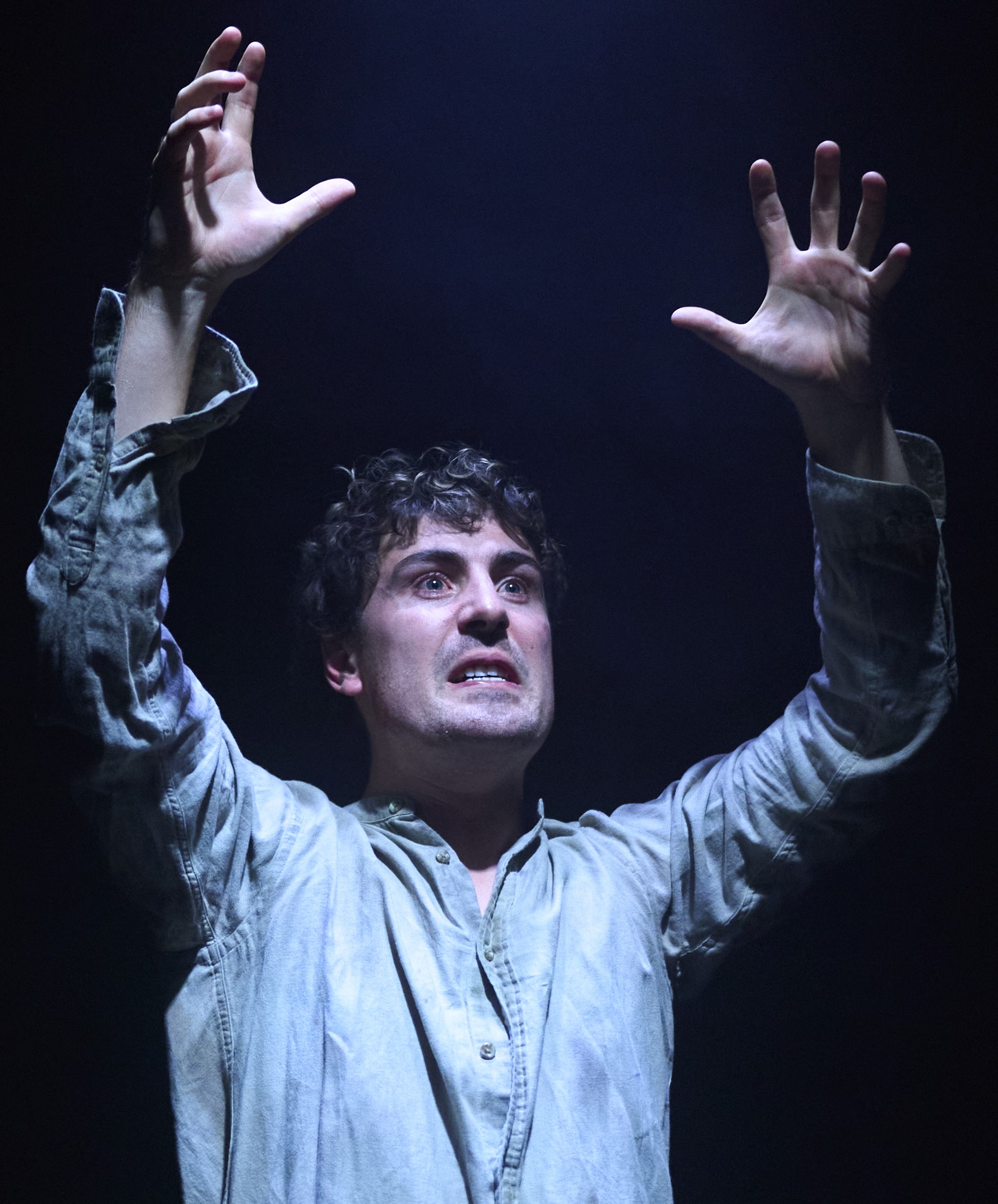
Almost as pivotal are the set (Keerthi Subramanyam), lighting (Verity Hampson) and sound (Ross Johnston). The opening sequence has Twelvetree casting shadows that are the visual the incarnation of his splitting personality. When he speaks with the Ghost, he plays both parts, changing his voice, and exposing his face to light as Hamlet; consigning it to shadow as the Ghost.
Such directorial flourishes abound, as when Labade stands on a chair to be Claudius, with a chandelier above his head becoming his crown, or when he movingly carries a dress draped across his arms to represent Ophelia’s dead body.
Ultimately, it’s a fantasia upon Hamlet’s mental and emotional disintegration, investigated with a cast of two rather than 12. Whether it offers greater illumination is another matter. Twelvetree’s delivery misses too many emotional king-hits inherent in the verse, and yet I enjoyed being discombobulated by something so familiar.
Until August 15.